
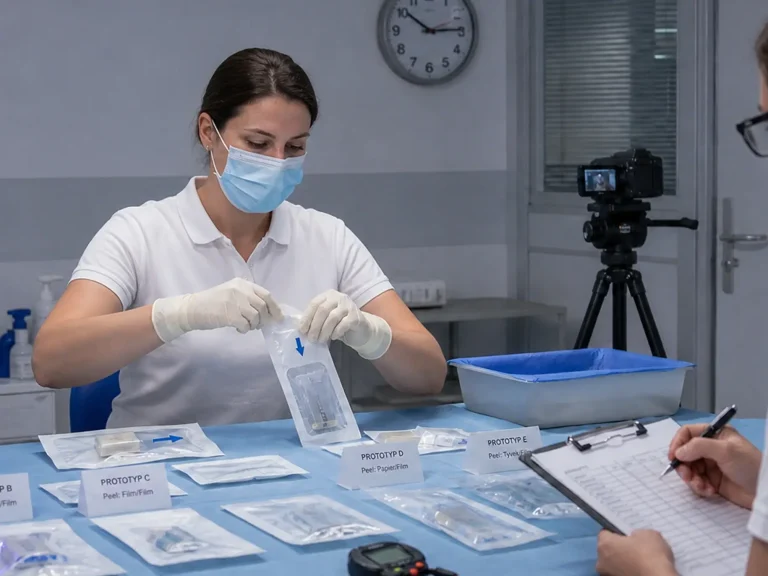
1 Why packaging is more than product protection
The primary function of medical device packaging is, of course, to protect the product, to maintain sterility up to the point of use and to avoid damage during storage and distribution. For sterile products, however, a second, equally critical function applies: the packaging must support users in presenting the product quickly, correctly and aseptically. Its quality is therefore measured not only by how well it protects a product, but also by how safely it prepares its use.
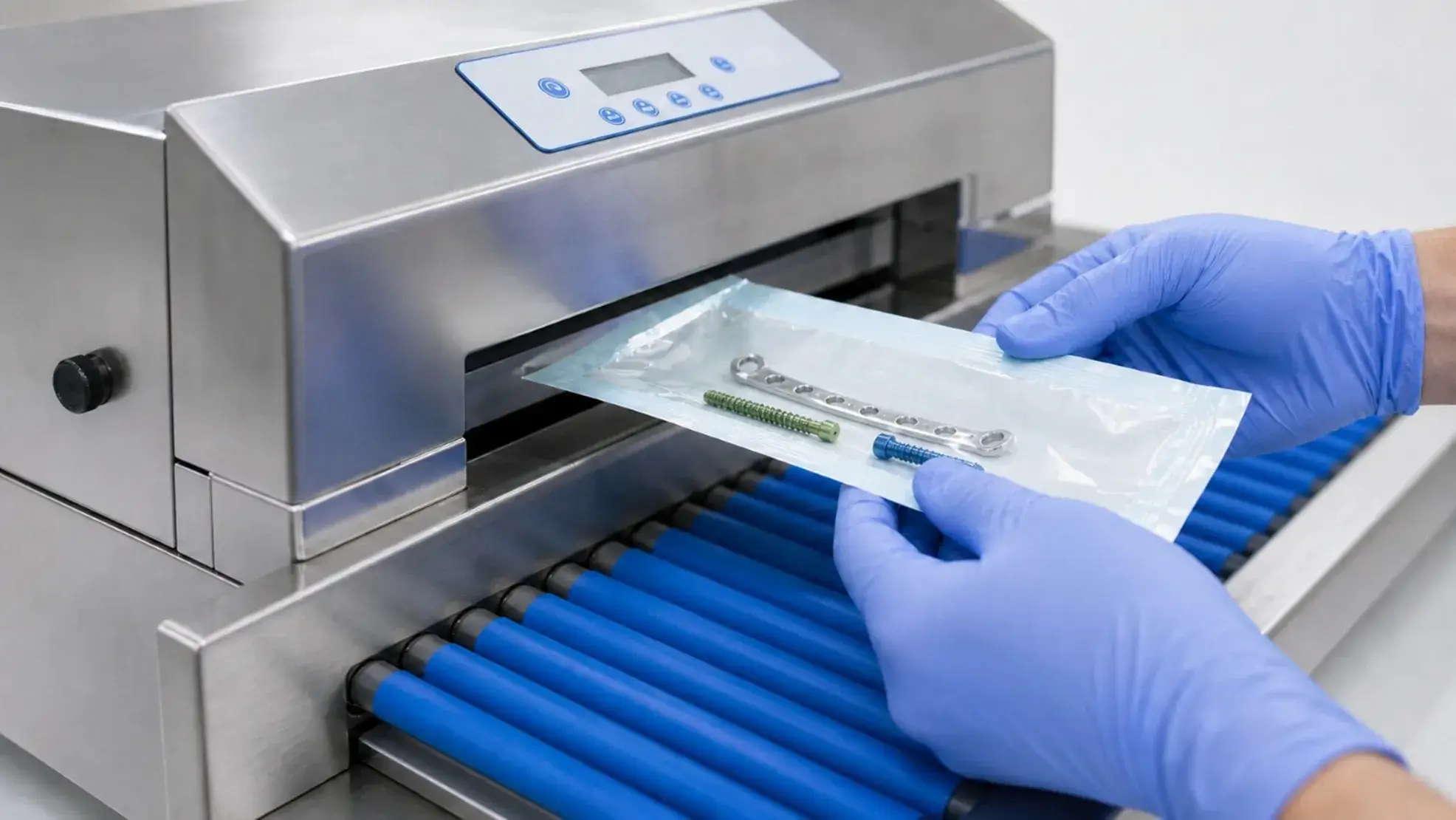
One decisive success factor is often overlooked: the first interaction with a sterile medical device does not take place at the product itself, but at its packaging.
It is exactly at this interface between packaging development, user interaction and clinical context of use that safety-relevant problems often arise in practice.
In the operating room, the cath lab, the emergency department or in outpatient care, packaging is rarely opened under ideal conditions. Users work under time pressure, with gloves, limited fine motor skills, sometimes restricted vision and high cognitive load. Under these conditions, seemingly small design features can have a considerable effect on how safely a product is presented.
Examples include:
- opening starting points that are hard to recognize
- high or inconsistent peel forces
- unclear removal directions
- unfavorable product orientations
- labeling that is hard to read
If relevant information is not found quickly or opening the packaging is made unnecessarily difficult, users often develop their own strategies to complete the task anyway. From a human factors perspective, this is not primarily an individual failure, but an indication of deficits in the usability of the system.
Not every packaging deviation leads to a packaging risk. Many packaging problems only become a use-related risk through the interaction with the user.
In this understanding, packaging usability becomes a distinct level of consideration. It describes the ability of a packaging system to support users in the safe, efficient and intended presentation of a product. For sterile medical devices in particular, it is therefore an essential building block for safe aseptic presentation and for avoiding use-related risks.
It becomes clear: packaging is not just a logistical or material component. It is part of an overall system of product, labeling, instructions for use, training and context of use. From a human factors perspective, packaging elements therefore also belong to the components that can influence the safe and effective use of a medical device.
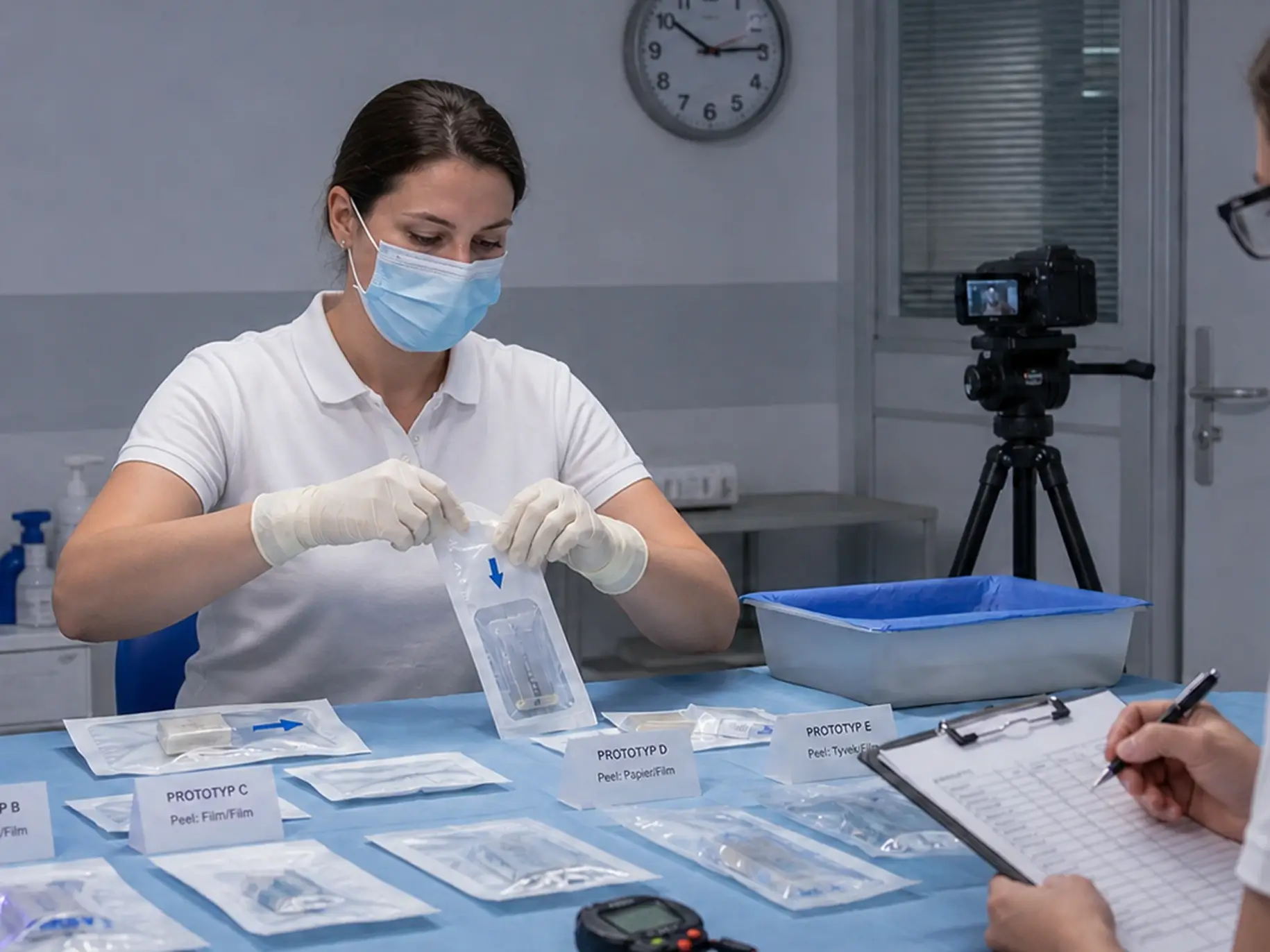
2 What risks arise from poor packaging usability?
Weaknesses in packaging usability can lead to relevant risks along the entire path of use. Particularly critical are contamination events during aseptic presentation, damage to the product when opening, wrong removals, mix-ups of similar variants and delays in clinical workflows. Many of these problems are not only packaging problems, they develop into use-related risks in the context of use. They rarely occur as isolated events, but are an expression of systemic design weaknesses.
Packaging errors often only become visible when users try to complete their task successfully despite an inadequate design.
Scientific studies show that the design of the packaging system can significantly influence the likelihood of contamination. Studies on the aseptic presentation of different sterile barrier systems indicate that certain packaging concepts support users better than others in presenting sterile products safely. Even seemingly small design features can have a relevant influence on the risk of contamination.
Studies show, for example, that factors such as the curling of the packaging material or the structure of a peel pouch can influence whether sterile contents come into contact with non-sterile surfaces. Packaging systems that support outward rolling of the material led to lower contact rates than alternative designs in the scenarios examined.
Typical consequences of insufficient packaging usability
1. Contamination of sterile products
2. Damage to the product when opening
3. Wrong removals or wrong orientations
4. Mix-up of similar product variants
5. Delays in clinical workflows
6. Increased cognitive load for users
In addition, many of these problems are not recognized or reported as packaging problems in the field. Clinical users often attribute difficulties with opening or aseptic presentation to individual clumsiness, time pressure or routine deviations. As a result, part of the actual usability problems remains underreported in complaint data, CAPA processes or post-market surveillance activities.
From the perspective of human factors engineering, this is particularly relevant. If users repeatedly develop workarounds or use packaging differently than intended, this should not be interpreted solely as user behavior. Often it is a signal that the packaging design does not sufficiently take the requirements of the real context of use into account.
Good packaging does not only prevent contamination. It prevents users from getting into situations in which contamination becomes more likely in the first place.
3 The regulatory framework: what is expected today
An important turning point was the revision of ISO 11607-1:2019. While earlier discussions about packaging were often dominated by material properties, seal integrity and validation of the barrier function, the current version explicitly contains new requirements for the usability evaluation of aseptic presentation. This acknowledges from a regulatory perspective that safe sterile presentation depends not only on material and process validation, but also on the real interaction of the user with the packaging. Human factors and usability standards, including IEC 62366-1 and AAMI HE75, focus on the interfaces of devices: controls, displays, software and workflows. The interaction with primary and secondary packaging belongs to this as well.
ISO 11607 requires not only proof of a functioning package. The standard also indirectly requires proof of a functioning interaction with that package.
Specifically, ISO 11607-1 requires a documented evaluation of whether sterile contents can be removed or presented aseptically from the sterile barrier system.
This evaluation should cover at least three aspects:
- the ability to identify the starting point for opening,
- the ability to recognize the required opening technique and to carry it out correctly without contaminating or damaging the contents or the packaging, and
- the ability to subsequently present the contents aseptically.
The topic is also relevant from the point of view of European regulation. The EU MDR emphasizes the need for safe handling and the avoidance of microbial contamination. Secondary literature and specialist publications therefore increasingly make clear that packaging should no longer be regarded as a side issue separate from the product, but as a safety-relevant part of the overall system.
4 Why packaging usability is still often considered too late in projects
Despite clearer regulatory requirements, packaging usability remains underrepresented in many development projects. The cause is usually not a lack of competence, but a lack of integration. Packaging engineers typically focus on material selection, seal strength, sterile barrier, manufacturability, cost and distribution testing. Human factors teams, on the other hand, often focus on the medical device itself, its controls, displays, software, labeling or instructions for use. Packaging thus sits between several disciplines and not infrequently falls through the organizational cracks.
Packaging usability is rarely a competence problem. More often it is an integration problem.
As a result, key decisions on packaging concepts are often made before representative users have even interacted with early design variants. At that point, functions, materials or packaging architectures are often already largely fixed. Insights from later user evaluation then no longer lead to small optimizations, but to potentially far-reaching changes.
Typical consequences are:
- adaptations of packaging concepts in late project phases
- additional verification and validation activities
- revalidation of packaging processes
- changes to labeling or IFU
- additional regulatory effort
The later use-related problems are recognized, the higher effort, costs and project risks generally become.
The cost of a design change rises with every development step. The cost of a missing user perspective often rises even faster.
A robust usability evaluation of medical device packaging should not be understood as an isolated one-time test at the end of a development project. It is rather a continuous process that considers packaging design, context of use and user interaction along the entire development cycle.
This is a particular feature of medical device packaging: many risks arise not from material failure or loss of the sterile barrier, but only during the interaction between user and packaging. If these interactions are only examined shortly before verification or validation, essential design decisions have often already been made.
Packaging problems often do not arise because nobody is responsible. They arise because each discipline looks at only a part of the overall interaction.
5 What a standards-compliant usability evaluation of packaging can look like
The decisive question is not whether a package can be opened. The decisive question is whether it can be opened safely under real conditions of use.
The starting point is therefore the analysis of the context of use. This is not only about the packaging itself but about the situation in which it is used. User groups, critical tasks, work environments and potential influencing factors have to be considered.
Examples include:
- sterile handovers in the operating room
- working with double gloves
- one-handed operation
- time pressure in emergency situations
- restricted visibility
- high cognitive load
Only when these conditions are understood can it be assessed which requirements a package actually has to meet.
Formative evaluation: recognize design weaknesses early
In the next step, early packaging concepts should be examined formatively. The aim is not the formal proof of usability, but the early identification of weaknesses in the design.
Typical questions are:
- Is the opening starting point recognized intuitively?
- Is the opening direction clear?
- Does the product stay correctly oriented after opening?
- Can the packaging be opened safely with gloved hands?
- Is there a risk for aseptic presentation?
- Is relevant information grasped quickly?
The earlier packaging usability is examined, the more likely it is that problems can be solved with design decisions instead of corrective actions.
Especially in early development phases, small studies with representative users can provide valuable insights and avoid costly changes in later project phases.
Summative evaluation: proof under realistic conditions
For the summative or validating evaluation, a use scenario that is as realistic as possible is decisive. The aim is to evaluate the packaging under conditions that come as close as possible to the later context of use.
Simulated clinical environments are often used for this. Published studies used, for example, simulated operating room scenarios and UV-based methods to make contacts between sterile and non-sterile surfaces visible. Such approaches enable a more objective evaluation of aseptic presentation and help to identify the causes of observed use difficulties systematically.
Tip
A package should never be evaluated in isolation. What is always relevant is the overall system of:
– packaging
– medical device
– labeling
– IFU
– context of use
– workflow
This is exactly why the summative evaluation should not only examine the opening of the packaging, but consider the complete task that users actually have to perform.
From packaging test to system evaluation
One of the most important insights of modern human factors approaches is that packaging problems rarely arise from individual material properties alone. What matters is the interaction between packaging, product and context of use.
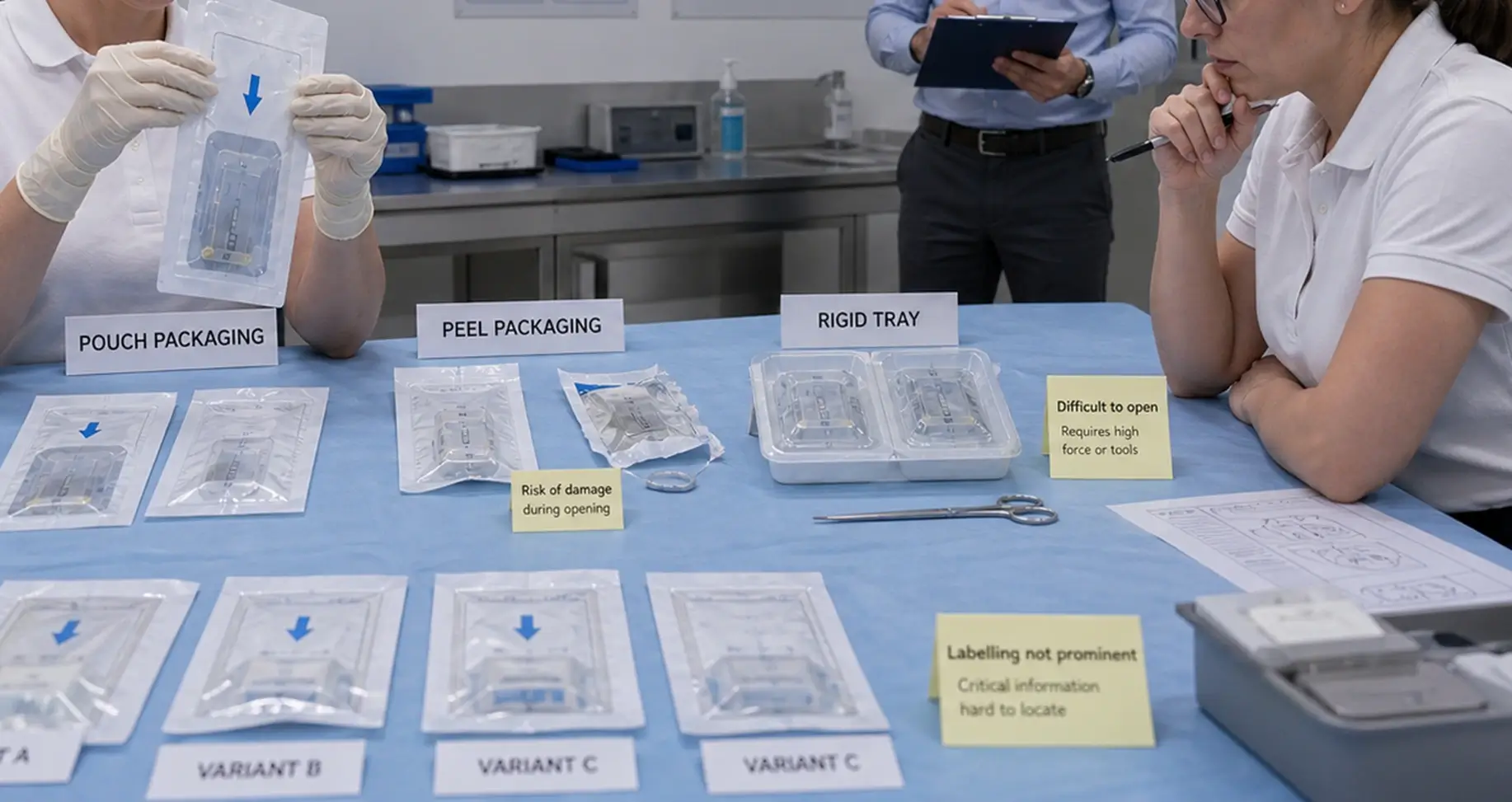
Packaging is not used under laboratory conditions, but in real workflows. That is exactly why its usability also has to be evaluated under realistic conditions.
A standards-compliant usability evaluation therefore delivers far more than regulatory evidence. It creates the basis for recognizing potential use-related risks early and for designing packaging systems so that they actively support the safe and efficient use of a medical device.
6 Which usability aspects are particularly relevant for packaging
Not every challenge in packaging projects is recognizable at first glance. In practice, however, the same questions keep appearing that have a direct influence on the safe and efficient use of a medical device. Many of these aspects look like details of the packaging design at first. In fact, they can be decisive for whether a product can be presented correctly and aseptically under real conditions of use.
Packaging usability is often decided not by individual design elements, but by the sum of many small interactions.
The following aspects are particularly relevant:
Findability of the opening starting point
Is it recognizable at first glance where and how the packaging has to be opened? Unclear opening points often lead to searching behavior, additional hand movements or improvised opening strategies.
Required opening force and handling
Can the packaging be opened safely with gloved hands without provoking jerky movements or the use of additional tools? Peel forces that are too high or inconsistent can impair both control of the product and aseptic presentation.
Contamination risk through material behavior
Does the packaging material behave predictably during opening? Unfavorable curling, uncontrolled tearing or problematic peel paths can cause sterile contents to come into contact with non-sterile surfaces.
Orientation and presentation of the contents
Is the product presented after opening in a way that supports safe, fast and correct removal? An unfavorable orientation can require additional manipulation and increase the risk of error.
Comprehensibility of labels and labeling
Can important information be grasped quickly and reliably? This includes, among other things:
- product identity
- product size or variant
- sterility status
- expiry date
- relevant distinguishing features
Especially under time pressure, this information must be immediately available.
Robustness against real contexts of use
Does the packaging concept also work under the conditions in which it will actually be used? Relevant influencing factors are, for example:
- time pressure
- distractions
- restricted vision
- working with gloves
- high workload
- unplanned interruptions
A package is not usable because it works under ideal conditions. It is usable when it also works under the conditions in which it is actually used.
These aspects are not cosmetic optimizations. In many cases they act as direct or indirect risk control measures. Their design influences whether users can perform critical tasks safely, efficiently and as intended.
Good packaging hardly stands out. Bad packaging forces users to shift their attention from the actual task to the packaging.
7 Recommendations for manufacturers
For manufacturers of sterile medical devices, this has a clear consequence: packaging development should not be viewed exclusively as a packaging topic. The safe presentation of a product arises at the interface of packaging design, user interaction and context of use. Accordingly, packaging usability should be understood as an interdisciplinary task from the start.
The decisive question is not whether a package stays sterile. The decisive question is whether its sterility can be presented safely under real conditions of use.
Packaging engineering, human factors engineering, risk management, clinical/medical, quality and regulatory affairs should therefore define joint requirements early and view packaging as part of the entire user interface system. Only in this way can technical, regulatory and use-related requirements be brought together systematically.
In practice, the following measures in particular have proven effective:
- include packaging in the use-related risk analysis in early concept phases
- carry out formative evaluations with representative users
- systematically simulate critical use situations
- link requirements from ISO 11607 and IEC 62366 early
- treat packaging usability as a distinct part of verification and validation strategies
- analyze packaging-related complaints and use signals systematically in the post-market phase
The most effective measure to improve packaging usability is not an additional test. It is the early integration of the user perspective.
Equally important is the continuous observation of real use experience after market launch. Difficulties with opening, improvisations during aseptic presentation or recurring workarounds often provide valuable indications of optimization potential, even if no formal complaints or safety-relevant events are reported.
Anyone who addresses packaging usability only shortly before design freeze or approval risks unnecessary iterations, increased validation effort and avoidable regulatory discussions. If packaging is instead considered early as part of the use system, risks can be controlled more robustly and design decisions can be made on a sounder basis.
The best time to consider packaging usability is before the first design decision. The second best time is before the first validation study.
Conclusion
The question today is no longer whether the usability of packaging is relevant, but how systematically it is integrated into development processes. Packaging does not only protect the product. It influences whether a medical device can be presented at the point of use safely, efficiently and free of contamination.
The safe use of a medical device often begins not with its application, but with its presentation.
This is exactly where the growing importance of packaging usability lies. The interaction between user and packaging helps decide whether a product can be used as intended. Packaging is therefore not only a packaging system, but at the same time part of the use system and a potential source of use-related risks.
The quality of medical device packaging is shown not only by how well it protects a product, but also by how safely it prepares its use.
The systematic evaluation of packaging usability requires close integration of packaging engineering, human factors engineering, risk management and regulatory know-how. Manufacturers that view packaging early as part of the user interface system create not only a more robust basis for compliance and risk management, but often also develop more robust and more user-friendly products.
Support along the development process
USE-Ing. accompanies manufacturers of medical devices from the early concept phase to summative validation. We support the identification of packaging-related use-related risks, the planning and execution of formative and summative usability evaluations and the standards-compliant documentation according to ISO 11607 and IEC 62366-1.
By using realistic use scenarios and established human factors methods, we help to identify critical weaknesses early and to develop robust packaging solutions.
Good packaging protects products. Excellent packaging also supports their safe use.
Please get in touch if you want to integrate packaging usability systematically into your development process. You can find more information on the process of a systematic usability engineering of packaging here:
Frequently asked questions about packaging usability
Further reading
- Human Factors & Usability Engineering for Medical Devices
- ISO 11607-1:2019, Packaging for terminally sterilized medical devices – Part 1: Requirements for materials, sterile barrier systems and packaging systems
- IEC 62366-1:2015+A1:2020, Medical devices – Part 1: Application of usability engineering to medical devices
- AAMI HE75:2025, Human Factors Engineering – Design of Medical Devices