Blog

Author: Dr.-Ing. Benedikt Janny

Testing Label Legibility Under Realistic Lighting Conditions

1 Legibility is not a property of the label alone

Font size, typeface, contrast and layout shape the label legibility on medical devices and packaging. From a human factors perspective, however, legibility only arises from the interplay of several factors:

  • label and packaging design,
  • printing and material properties,
  • lighting conditions,
  • viewing angle and distance,
  • visual acuity and vision aids of the users,
  • available time and parallel tasks,
  • prior knowledge and expectations regarding the information being sought.

Label legibility is therefore a sub-area of packaging usability. A basic classification of packaging as part of the user interface can be found in the article Usability evaluation of medical device packaging. This article addresses one section of it: the question of how the recognizability of information can be investigated realistically.

Labeling is part of the user interface: the FDA Human Factors Guidance explicitly names packaging, labeling and training materials as examples in its definition of the user interface, and in usability engineering according to IEC 62366-1, accompanying information is also considered together with the product. The IMDRF principles of labeling likewise require that the medium, format, content, legibility and position of the labeling suit the device, its purpose and its users.

In addition, ISO 20417 specifies which information the manufacturer must provide, and ISO 15223-1 specifies which symbols are used on the labeling of medical devices. Both standards describe what belongs on a label and how symbols are to be used. Whether the information is actually found and understood in the context of use is only shown by the usability evaluation.

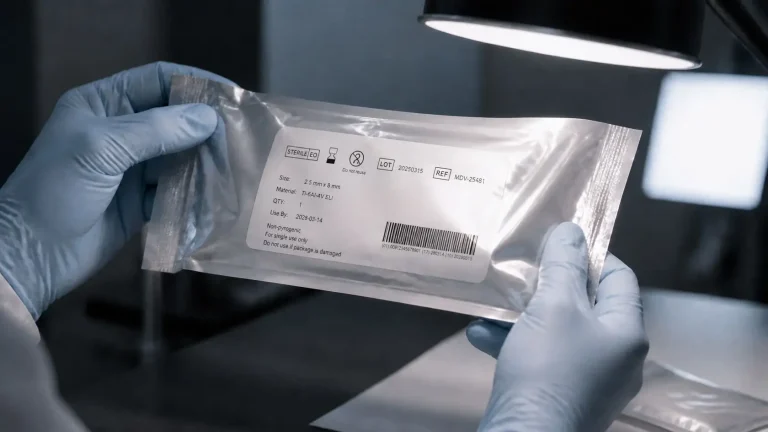
A label can be clearly recognizable under controlled conditions and still be overlooked or misinterpreted in the context of use. Particularly susceptible are glossy surfaces, low contrast, small print, visually similar product variants and information that only becomes visible when the packaging is turned.

The question is not “Is the label legible?”, but: “Does the intended user group find and understand the relevant information in time under the foreseeable conditions?”

2 Why lighting conditions make the difference

Light does not only affect whether characters are visible. It also changes information search, color recognition and the differentiation of similar design elements. Relevant influencing factors include, for example:

  • reduced ambient lighting,
  • directional light and cast shadows,
  • glare and reflections on films or coated surfaces,
  • different color temperatures,
  • changes between bright and dark areas, for example between a display and the surroundings.

Which conditions belong in a test follows from the context of use and the disturbing factors of the use environment. Packaging for a brightly lit preparation room places different demands than a product used in a darkened examination room, in an emergency response or in the home environment.

2.1 User group and vision conditions

Light does not affect all users equally. How well information is recognized under reduced lighting or glare also depends on visual acuity. Vision aids, protective glasses or visors can change the field of view and contrast perception. For products intended for home use, lay users with very different visual acuity are added.

These differences belong in the description of the intended users and in the user profile. They determine which participants are needed for a readability test and which aids are permitted in the test. A test that is conducted only with participants with very good visual acuity and without protective equipment underestimates the difficulties in everyday use.

Change of perspective

In a project, a label is usually released on screen or on a printout at a desk. It is used in a completely different situation: with the product in hand, wearing gloves, under time pressure and with attention on the next task. The release situation is therefore no substitute for the context of use.

3 Four levels of legibility

To make clear where a difficulty arises, four levels should be observed separately in the test.

3.1 Visual perceptibility

Can users perceive characters, symbols, colors and boundaries? Influencing variables are font size, stroke width, contrast, surface reflection, print quality, distance, angle and illuminance. The wiki entry Perception describes the fundamentals.

3.2 Findability

Do users find the information they need? Information hierarchy, grouping, position and visual anchors count here. An item can be easily legible and still not be found because it is located in an unexpected place.

3.3 Distinguishability

Can similar product variants or items of information be reliably told apart? This is particularly important when the packaging of a product family is structured identically and differs only in color, abbreviation or small parts of the text.

3.4 Comprehensibility

Do users understand the information they have found as it is intended? Purely text-based methods, which evaluate word and sentence lengths, for example, give indications of linguistic complexity. However, they do not show whether users implement information correctly in a specific situation.

Why the separation matters

If the four levels are not recorded separately, it remains unclear whether a problem arises from poor visibility, from the information architecture or from a comprehension problem. The design measure is then guessed rather than justified.

4 What can be investigated formatively

A formative usability evaluation is intended to identify weaknesses early and improve design solutions. Typical questions for labels are:

  • Which information do users look at first?
  • Is safety-relevant information found in time?
  • Which items of information are overlooked under reduced lighting?
  • Do reflections or glare occur that prevent reading?
  • Are similar variants confused?
  • Does the search strategy change under different light?
  • Which information is found but misinterpreted?

Compensation strategies are particularly revealing. When participants turn a package several times, bring it closer to their face, hold it up to the light, use a lamp or ask others for help, this shows potential for optimization, even if the task is solved in the end.

In our readability tests we see this behavior again and again: participants turn the packaging, bring it closer to their eyes or hold it up to the light before they find the information they are looking for. This is exactly where the root cause analysis begins.

4.1 When to test in the development process?

A readability test is worthwhile as soon as the layout and information hierarchy of a label are fixed, but print data and packaging material can still be changed. Early on, printouts on the intended material or simple samples are often sufficient. Later, near-series samples with the original surface should be tested, because gloss, film and printing process strongly influence reflection. A second, shorter round after design changes shows whether the measures work and no new problems have arisen. A test is also useful when a product family is extended by new variants, because the risk of confusion then increases.

5 A possible study design

5.1 Analyze the context of use

Before selecting the lighting conditions, clarify: Who uses the product, where and at what time? Which information must be recognized then? Which use errors or delays could occur? Not every conceivable lighting situation has to be simulated. The selection should be derived from the context of use and the use-related risk analysis, for example from the hazard-related use scenarios.

5.2 Define information tasks

Instead of asking whether a label is legible, formulate concrete tasks, for example:

  • Identify the required product variant.
  • Find the size specification.
  • Locate the warning notice.
  • Distinguish between two similarly designed variants.
  • Determine the next action step.

Task-based tests show whether the labeling supports actual use.

5.3 Vary lighting conditions in a controlled way

Depending on the context of use, several defined conditions can be investigated, for example reference lighting, reduced lighting, directional light, unfavorable incident light with reflection and the change between a bright and a dark environment. The conditions should be documented and reproducible. In addition, viewing angle, distance and available time can be varied.

We conduct such readability tests in our Medical Usability Test Lab. The lighting there can be adjusted from complete darkness to operating room lighting. This allows us to recreate both darkened examination and patient rooms and brightly lit procedural situations, and to keep the conditions the same for each session.

DIN EN 12464-1 can serve as a guide for realistic lighting levels. The standard describes requirements for the lighting of indoor workplaces, including areas in healthcare. Decisive for the test, however, remains the specific context of use of the product.

5.4 Capture behavior instead of opinion

Statements such as “I could read that well” are helpful, but should not be the only data source. More meaningful are observable data: time to find the information, area looked at first, repeated searching, turning or tilting of the packaging, shortened distance, confusions, omitted information and the success rate per information task. The think-aloud method can additionally show what participants are looking for.

5.5 Debrief on causes

Ask specifically after each task: What was difficult to recognize? Where was the information expected? What helped, what distracted? Was the difficulty visual, linguistic or structural? The goal is not a list of preferences, but a traceable link between context of use, observed behavior and design cause, that is, a root cause analysis.

5.6 Select participants

A formative readability test does not require large samples, but it does require the right participants. They should represent the intended user groups, including typical vision aids and, where relevant, the protective equipment worn in the context of use. Also include participants with different lengths of professional experience. Experience can influence how information is searched for, for example whether someone relies on familiar positions and colors or reads the label completely. More on selection can be found in the wiki entry Representative users.

5.7 Document test conditions

So that results are traceable and later iterations are comparable, the conditions should be recorded for each session: illuminance at the label, type and position of the light sources, color temperature, viewing distance and angle, and the prototype or print status used. Photos of the setup from the participants’ point of view help with later root cause analysis. This documentation is also the bridge to the summative evaluation: it shows which conditions have already been investigated and which still have to be covered there.

Classic approachNew approach
Check the label in the office on screen or on a printoutTest the label in the context of use under defined lighting conditions
Question: “Can you read this?”Concrete information tasks with an observable outcome
Legibility as one attributePerceptibility, findability, distinguishability and comprehensibility separately
Satisfaction rating by the participantsBehavior, compensation strategies and errors as the main data
“Fixing” individual problems directlyAnalyze the cause, adapt the design, investigate again

6 What a formative readability test can and cannot do

A formative test can make weaknesses visible early, compare design variants, identify problematic lighting and viewing situations, support the use-related risk analysis and make requirements for the later summative evaluation more concrete.

However, it is not conclusive proof. Especially with small samples or non-final prototypes, no general statements about the usability of the final product can be derived. The communication of results should reflect this clearly: the formative evaluation identifies possible weaknesses and supports design decisions. It does not prove that a label is safely legible under all lighting conditions.

For the regulatory classification, the distinction is important: IEC 62366-1 distinguishes formative evaluations, which iteratively improve the design, from the summative evaluation, which demonstrates safe use on the final design. Questions about the legibility of safety-relevant labeling that remain open formatively should therefore flow into the planning of the summative evaluation as concrete tasks or knowledge questions.

For product and development teams, early testing is worthwhile mainly for one reason: confusion of similar variants or late label changes shortly before the summative evaluation or market launch cost time, because print data, packaging and documentation have to be adapted again.

7 From observation to design decision

The value of a formative evaluation only arises through its translation into measures. Possible measures are higher contrast, adjusted font size or stroke width, less glossy surfaces, a different prioritization and grouping of content, critical information on several visible surfaces, stronger differentiation of similar variants, color coding with additional features and clearer symbols.

Do not correct every observation in isolation. Changes create new interactions. A larger font can improve legibility and at the same time change information density and hierarchy. An iterative sequence has proven effective: observe, analyze the cause, adapt the design, investigate again.

A simple matrix helps to translate observations into measures in a structured way:

ObservationPossible causePossible measure
Information is overlooked under reduced lightContrast or stroke width too lowIncrease contrast, adjust stroke width
Participants tilt the packaging several timesReflection on glossy surfaceMatte surface in the information area, change position
Variants are confusedDifference only through color or abbreviationAdditional distinguishing feature (shape, symbol, text size)
Information is found but misunderstoodTerm or symbol ambiguousRevise wording or symbol, check comprehension again
Long search time despite good visibilityInformation in an unexpected placeAdapt information hierarchy and grouping

Each row is a hypothesis that is verified in the next round.

Quick check: 7 questions before the readability test

  1. Have user groups, vision conditions and vision aids been considered?
  2. Have the critical information tasks been defined?
  3. Are the lighting conditions derived from the context of use and the risk analysis?
  4. Are reflections, angle and distance taken into account?
  5. Are perceptibility, findability, distinguishability and comprehensibility recorded separately?
  6. Are behavior, compensation strategies and confusions observed and not only asked about?
  7. Are the conditions documented reproducibly, and is it defined how results are translated into design requirements?

Conclusion

Labels are not static carriers of information, but part of the user interface. Whether labeling works depends not only on font size, contrast and mandatory information, but on whether relevant information is found, distinguished and understood under realistic conditions.

Formative readability tests under varying lighting conditions make exactly this interaction visible early. They create a robust basis for design decisions and for planning the summative evaluation.

In the Medical Usability Test Lab of USE-Ing., we investigate labeling and packaging under defined lighting conditions and translate observations into concrete design requirements. If you would like to test a label realistically before release, get in touch with us.

A label must not only be visible. It must work at the right moment, under the actual conditions and for the intended user group.

Frequently asked questions about label legibility

Label legibility describes whether the intended user group can recognize, find, distinguish and correctly understand the information on a label under the foreseeable conditions of use. It is more than font size and contrast.

Because light changes visibility, color recognition and search behavior. Reduced lighting, reflections on films or directional light can cause information that is easily legible in the office to be overlooked in the context of use.

The conditions that are realistic or reasonably foreseeable in the context of use. They are derived from the context analysis and the use-related risk analysis, for example reference light, reduced lighting, directional light with reflection and bright-dark transitions.

No. A formative test identifies weaknesses and supports design decisions. It is not proof that a final label can be used safely under all conditions.

Above all observable behavior: time to find the information, confusions, omitted information, misinterpretations and compensation strategies such as turning the packaging or shortening the distance. Self-reports complement these data.

Further content

Sources

Usability Evaluation of Medical Device Packaging

1 Why packaging is more than product protection

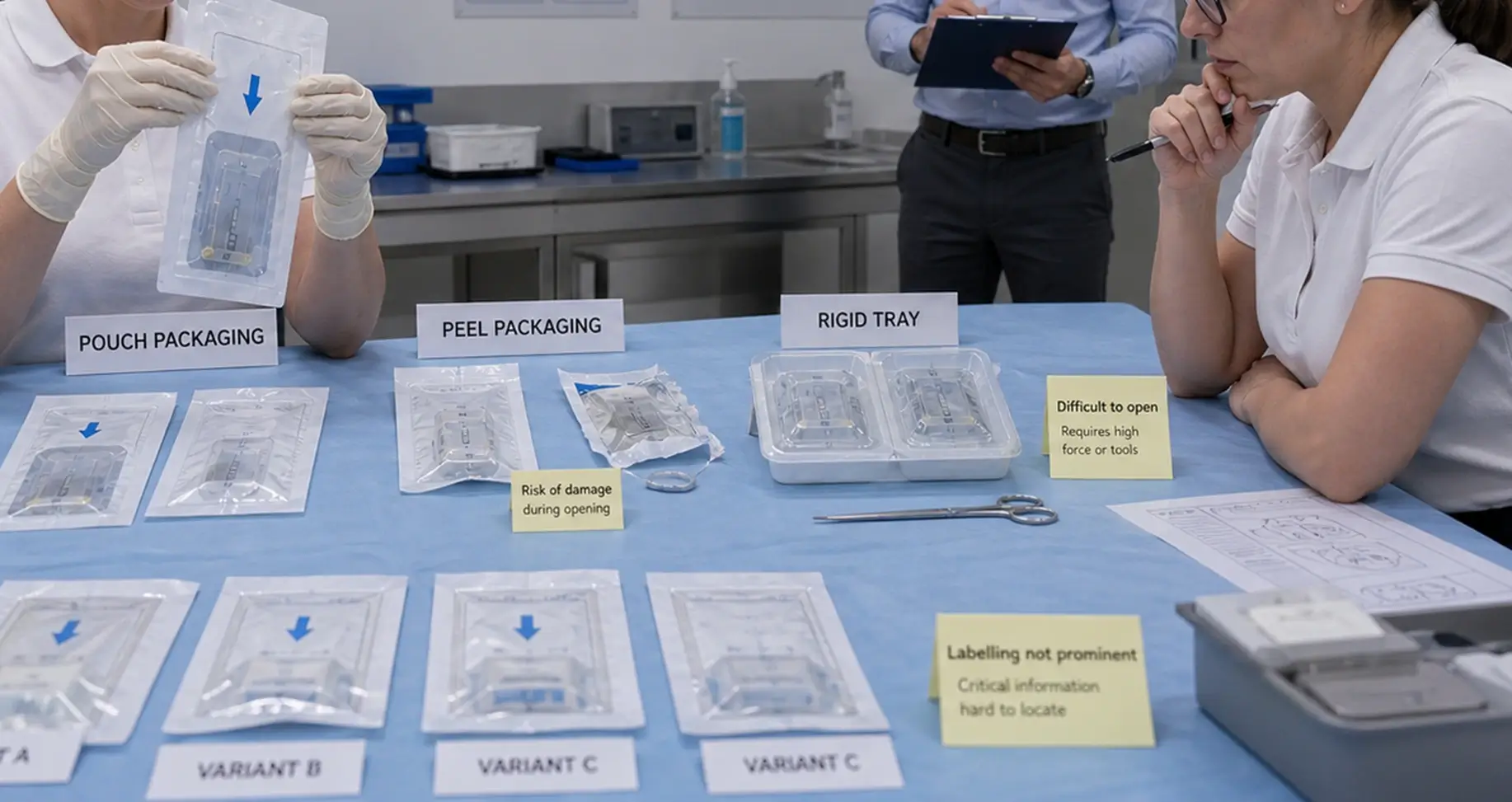
The primary function of medical device packaging is, of course, to protect the product, to maintain sterility up to the point of use and to avoid damage during storage and distribution. For sterile products, however, a second, equally critical function applies: the packaging must support users in presenting the product quickly, correctly and aseptically. Its quality is therefore measured not only by how well it protects a product, but also by how safely it prepares its use.

Packaging usability engineering

One decisive success factor is often overlooked: the first interaction with a sterile medical device does not take place at the product itself, but at its packaging.

It is exactly at this interface between packaging development, user interaction and clinical context of use that safety-relevant problems often arise in practice.

In the operating room, the cath lab, the emergency department or in outpatient care, packaging is rarely opened under ideal conditions. Users work under time pressure, with gloves, limited fine motor skills, sometimes restricted vision and high cognitive load. Under these conditions, seemingly small design features can have a considerable effect on how safely a product is presented.

Examples include:

  • opening starting points that are hard to recognize
  • high or inconsistent peel forces
  • unclear removal directions
  • unfavorable product orientations
  • labeling that is hard to read

If relevant information is not found quickly or opening the packaging is made unnecessarily difficult, users often develop their own strategies to complete the task anyway. From a human factors perspective, this is not primarily an individual failure, but an indication of deficits in the usability of the system.

Not every packaging deviation leads to a packaging risk. Many packaging problems only become a use-related risk through the interaction with the user.

In this understanding, packaging usability becomes a distinct level of consideration. It describes the ability of a packaging system to support users in the safe, efficient and intended presentation of a product. For sterile medical devices in particular, it is therefore an essential building block for safe aseptic presentation and for avoiding use-related risks.

It becomes clear: packaging is not just a logistical or material component. It is part of an overall system of product, labeling, instructions for use, training and context of use. From a human factors perspective, packaging elements therefore also belong to the components that can influence the safe and effective use of a medical device.

Packaging usability engineering

2 What risks arise from poor packaging usability?

Weaknesses in packaging usability can lead to relevant risks along the entire path of use. Particularly critical are contamination events during aseptic presentation, damage to the product when opening, wrong removals, mix-ups of similar variants and delays in clinical workflows. Many of these problems are not only packaging problems, they develop into use-related risks in the context of use. They rarely occur as isolated events, but are an expression of systemic design weaknesses.

Packaging errors often only become visible when users try to complete their task successfully despite an inadequate design.

Scientific studies show that the design of the packaging system can significantly influence the likelihood of contamination. Studies on the aseptic presentation of different sterile barrier systems indicate that certain packaging concepts support users better than others in presenting sterile products safely. Even seemingly small design features can have a relevant influence on the risk of contamination.

Studies show, for example, that factors such as the curling of the packaging material or the structure of a peel pouch can influence whether sterile contents come into contact with non-sterile surfaces. Packaging systems that support outward rolling of the material led to lower contact rates than alternative designs in the scenarios examined.

Typical consequences of insufficient packaging usability

1. Contamination of sterile products
2. Damage to the product when opening
3. Wrong removals or wrong orientations
4. Mix-up of similar product variants
5. Delays in clinical workflows
6. Increased cognitive load for users

In addition, many of these problems are not recognized or reported as packaging problems in the field. Clinical users often attribute difficulties with opening or aseptic presentation to individual clumsiness, time pressure or routine deviations. As a result, part of the actual usability problems remains underreported in complaint data, CAPA processes or post-market surveillance activities.

From the perspective of human factors engineering, this is particularly relevant. If users repeatedly develop workarounds or use packaging differently than intended, this should not be interpreted solely as user behavior. Often it is a signal that the packaging design does not sufficiently take the requirements of the real context of use into account.

Good packaging does not only prevent contamination. It prevents users from getting into situations in which contamination becomes more likely in the first place.

3 The regulatory framework: what is expected today

An important turning point was the revision of ISO 11607-1:2019. While earlier discussions about packaging were often dominated by material properties, seal integrity and validation of the barrier function, the current version explicitly contains new requirements for the usability evaluation of aseptic presentation. This acknowledges from a regulatory perspective that safe sterile presentation depends not only on material and process validation, but also on the real interaction of the user with the packaging. Human factors and usability standards, including IEC 62366-1 and AAMI HE75, focus on the interfaces of devices: controls, displays, software and workflows. The interaction with primary and secondary packaging belongs to this as well.

ISO 11607 requires not only proof of a functioning package. The standard also indirectly requires proof of a functioning interaction with that package.

Specifically, ISO 11607-1 requires a documented evaluation of whether sterile contents can be removed or presented aseptically from the sterile barrier system.

This evaluation should cover at least three aspects:

  1. the ability to identify the starting point for opening,
  2. the ability to recognize the required opening technique and to carry it out correctly without contaminating or damaging the contents or the packaging, and
  3. the ability to subsequently present the contents aseptically.

The topic is also relevant from the point of view of European regulation. The EU MDR emphasizes the need for safe handling and the avoidance of microbial contamination. Secondary literature and specialist publications therefore increasingly make clear that packaging should no longer be regarded as a side issue separate from the product, but as a safety-relevant part of the overall system.

4 Why packaging usability is still often considered too late in projects

Despite clearer regulatory requirements, packaging usability remains underrepresented in many development projects. The cause is usually not a lack of competence, but a lack of integration. Packaging engineers typically focus on material selection, seal strength, sterile barrier, manufacturability, cost and distribution testing. Human factors teams, on the other hand, often focus on the medical device itself, its controls, displays, software, labeling or instructions for use. Packaging thus sits between several disciplines and not infrequently falls through the organizational cracks.

Packaging usability is rarely a competence problem. More often it is an integration problem.

As a result, key decisions on packaging concepts are often made before representative users have even interacted with early design variants. At that point, functions, materials or packaging architectures are often already largely fixed. Insights from later user evaluation then no longer lead to small optimizations, but to potentially far-reaching changes.

Typical consequences are:

  • adaptations of packaging concepts in late project phases
  • additional verification and validation activities
  • revalidation of packaging processes
  • changes to labeling or IFU
  • additional regulatory effort

The later use-related problems are recognized, the higher effort, costs and project risks generally become.

The cost of a design change rises with every development step. The cost of a missing user perspective often rises even faster.

A robust usability evaluation of medical device packaging should not be understood as an isolated one-time test at the end of a development project. It is rather a continuous process that considers packaging design, context of use and user interaction along the entire development cycle.

This is a particular feature of medical device packaging: many risks arise not from material failure or loss of the sterile barrier, but only during the interaction between user and packaging. If these interactions are only examined shortly before verification or validation, essential design decisions have often already been made.

Packaging problems often do not arise because nobody is responsible. They arise because each discipline looks at only a part of the overall interaction.

5 What a standards-compliant usability evaluation of packaging can look like

The decisive question is not whether a package can be opened. The decisive question is whether it can be opened safely under real conditions of use.

The starting point is therefore the analysis of the context of use. This is not only about the packaging itself but about the situation in which it is used. User groups, critical tasks, work environments and potential influencing factors have to be considered.

Examples include:

  • sterile handovers in the operating room
  • working with double gloves
  • one-handed operation
  • time pressure in emergency situations
  • restricted visibility
  • high cognitive load

Only when these conditions are understood can it be assessed which requirements a package actually has to meet.

Formative evaluation: recognize design weaknesses early

In the next step, early packaging concepts should be examined formatively. The aim is not the formal proof of usability, but the early identification of weaknesses in the design.

Typical questions are:

  • Is the opening starting point recognized intuitively?
  • Is the opening direction clear?
  • Does the product stay correctly oriented after opening?
  • Can the packaging be opened safely with gloved hands?
  • Is there a risk for aseptic presentation?
  • Is relevant information grasped quickly?

The earlier packaging usability is examined, the more likely it is that problems can be solved with design decisions instead of corrective actions.

Especially in early development phases, small studies with representative users can provide valuable insights and avoid costly changes in later project phases.

Summative evaluation: proof under realistic conditions

For the summative or validating evaluation, a use scenario that is as realistic as possible is decisive. The aim is to evaluate the packaging under conditions that come as close as possible to the later context of use.

Simulated clinical environments are often used for this. Published studies used, for example, simulated operating room scenarios and UV-based methods to make contacts between sterile and non-sterile surfaces visible. Such approaches enable a more objective evaluation of aseptic presentation and help to identify the causes of observed use difficulties systematically.

Tip

A package should never be evaluated in isolation. What is always relevant is the overall system of:
– packaging
– medical device
– labeling
– IFU
– context of use
– workflow

This is exactly why the summative evaluation should not only examine the opening of the packaging, but consider the complete task that users actually have to perform.

From packaging test to system evaluation

One of the most important insights of modern human factors approaches is that packaging problems rarely arise from individual material properties alone. What matters is the interaction between packaging, product and context of use.

Packaging usability engineering

Packaging is not used under laboratory conditions, but in real workflows. That is exactly why its usability also has to be evaluated under realistic conditions.

A standards-compliant usability evaluation therefore delivers far more than regulatory evidence. It creates the basis for recognizing potential use-related risks early and for designing packaging systems so that they actively support the safe and efficient use of a medical device.

6 Which usability aspects are particularly relevant for packaging

Not every challenge in packaging projects is recognizable at first glance. In practice, however, the same questions keep appearing that have a direct influence on the safe and efficient use of a medical device. Many of these aspects look like details of the packaging design at first. In fact, they can be decisive for whether a product can be presented correctly and aseptically under real conditions of use.

Packaging usability is often decided not by individual design elements, but by the sum of many small interactions.

The following aspects are particularly relevant:

Findability of the opening starting point

Is it recognizable at first glance where and how the packaging has to be opened? Unclear opening points often lead to searching behavior, additional hand movements or improvised opening strategies.

Required opening force and handling

Can the packaging be opened safely with gloved hands without provoking jerky movements or the use of additional tools? Peel forces that are too high or inconsistent can impair both control of the product and aseptic presentation.

Contamination risk through material behavior

Does the packaging material behave predictably during opening? Unfavorable curling, uncontrolled tearing or problematic peel paths can cause sterile contents to come into contact with non-sterile surfaces.

Orientation and presentation of the contents

Is the product presented after opening in a way that supports safe, fast and correct removal? An unfavorable orientation can require additional manipulation and increase the risk of error.

Comprehensibility of labels and labeling

Can important information be grasped quickly and reliably? This includes, among other things:

  • product identity
  • product size or variant
  • sterility status
  • expiry date
  • relevant distinguishing features

Especially under time pressure, this information must be immediately available.

Robustness against real contexts of use

Does the packaging concept also work under the conditions in which it will actually be used? Relevant influencing factors are, for example:

  • time pressure
  • distractions
  • restricted vision
  • working with gloves
  • high workload
  • unplanned interruptions

A package is not usable because it works under ideal conditions. It is usable when it also works under the conditions in which it is actually used.

These aspects are not cosmetic optimizations. In many cases they act as direct or indirect risk control measures. Their design influences whether users can perform critical tasks safely, efficiently and as intended.

Good packaging hardly stands out. Bad packaging forces users to shift their attention from the actual task to the packaging.

7 Recommendations for manufacturers

For manufacturers of sterile medical devices, this has a clear consequence: packaging development should not be viewed exclusively as a packaging topic. The safe presentation of a product arises at the interface of packaging design, user interaction and context of use. Accordingly, packaging usability should be understood as an interdisciplinary task from the start.

The decisive question is not whether a package stays sterile. The decisive question is whether its sterility can be presented safely under real conditions of use.

Packaging engineering, human factors engineering, risk management, clinical/medical, quality and regulatory affairs should therefore define joint requirements early and view packaging as part of the entire user interface system. Only in this way can technical, regulatory and use-related requirements be brought together systematically.

In practice, the following measures in particular have proven effective:

  • include packaging in the use-related risk analysis in early concept phases
  • carry out formative evaluations with representative users
  • systematically simulate critical use situations
  • link requirements from ISO 11607 and IEC 62366 early
  • treat packaging usability as a distinct part of verification and validation strategies
  • analyze packaging-related complaints and use signals systematically in the post-market phase

The most effective measure to improve packaging usability is not an additional test. It is the early integration of the user perspective.

Equally important is the continuous observation of real use experience after market launch. Difficulties with opening, improvisations during aseptic presentation or recurring workarounds often provide valuable indications of optimization potential, even if no formal complaints or safety-relevant events are reported.

Anyone who addresses packaging usability only shortly before design freeze or approval risks unnecessary iterations, increased validation effort and avoidable regulatory discussions. If packaging is instead considered early as part of the use system, risks can be controlled more robustly and design decisions can be made on a sounder basis.

The best time to consider packaging usability is before the first design decision. The second best time is before the first validation study.

Conclusion

The question today is no longer whether the usability of packaging is relevant, but how systematically it is integrated into development processes. Packaging does not only protect the product. It influences whether a medical device can be presented at the point of use safely, efficiently and free of contamination.

The safe use of a medical device often begins not with its application, but with its presentation.

This is exactly where the growing importance of packaging usability lies. The interaction between user and packaging helps decide whether a product can be used as intended. Packaging is therefore not only a packaging system, but at the same time part of the use system and a potential source of use-related risks.

The quality of medical device packaging is shown not only by how well it protects a product, but also by how safely it prepares its use.

The systematic evaluation of packaging usability requires close integration of packaging engineering, human factors engineering, risk management and regulatory know-how. Manufacturers that view packaging early as part of the user interface system create not only a more robust basis for compliance and risk management, but often also develop more robust and more user-friendly products.

Support along the development process

USE-Ing. accompanies manufacturers of medical devices from the early concept phase to summative validation. We support the identification of packaging-related use-related risks, the planning and execution of formative and summative usability evaluations and the standards-compliant documentation according to ISO 11607 and IEC 62366-1.

By using realistic use scenarios and established human factors methods, we help to identify critical weaknesses early and to develop robust packaging solutions.

Good packaging protects products. Excellent packaging also supports their safe use.

Please get in touch if you want to integrate packaging usability systematically into your development process. You can find more information on the process of a systematic usability engineering of packaging here:

Usability engineering of packaging

Frequently asked questions about packaging usability

Packaging usability describes the ability of a packaging system to support users in the safe, efficient and intended presentation of a medical device. In addition to product protection, it covers aspects such as opening, handling, perception of information and aseptic presentation.

From a human factors engineering perspective, packaging elements can be part of the user interface system if they influence the safe identification, preparation or use of a medical device. This applies in particular to sterile medical devices.

ISO 11607 requires an evaluation of the aseptic presentation of sterile medical devices. This puts the focus not only on the technical integrity of the packaging but also on the user’s interaction with the packaging system.

Typical risks are contamination during aseptic presentation, product damage when opening, mix-ups, delays in clinical workflows and other packaging-related use-related risks.

Ideally already in early concept phases. Formative evaluations help to identify design weaknesses early, before packaging concepts are validated or submitted to regulators.

Further reading

Usability Engineering for AI-enabled Medical Devices

Usability engineering for AI-enabled medical devices

Usability Engineering for AI-enabled Medical Devices

Practical implications for the usability engineering of AI-enabled medical devices

May 2026

Dr. Benedikt Janny, Katrin Gernert

Executive Summary

Kopie von auditive Visual Haptical Feedback 3
Usability engineering for AI-enabled medical devices confronts manufacturers with new challenges, because artificial intelligence (AI) fundamentally changes medical technology, both in how devices work technically and in the interaction between human and device. Usability engineering for AI-enabled medical devices therefore places new demands on human factors, risk management and regulatory processes. While classic medical devices rely on fixed parameters and respond predictably in identical situations, AI-based systems generate probabilistic, varying and context-dependent outputs. This dynamic considerably affects clinical workflows, role models and the cognitive demands on users.

For the safe integration of AI into medical products, the usability engineering process moves further into focus: user profiles change, tasks shift toward the assessment, plausibility check and critical interpretation of AI outputs in the sense of a human-in-the-loop (HITL) and human oversight paradigm, and new potential risks arise, in particular from misinterpretation or missing plausibility checks. At the same time, variable AI outputs and possible system errors make it harder to draw a clear line between a use error and a product error, model limitation or data-induced error.

The article shows how these changes affect all central deliverables of usability engineering, from the use specification as an increasingly dynamic artifact and the task analysis to hazard considerations, usability tests and post-market surveillance. It emphasizes the need for close collaboration between usability experts, clinical departments, risk management and AI development, as well as the importance of continuous monitoring after market launch in the context of Good Machine Learning Practice (GMLP) and AI lifecycle management. The goal is to integrate AI-enabled medical devices into existing clinical workflows in a safe, understandable and reliable way while ensuring patient and user safety as far as possible.

1AI-enabled Medical Devices & Human-AI Interaction

Artificial intelligence has become indispensable in both private and professional everyday life and is increasingly finding its way into medical technology. Alongside numerous benefits, this development also brings challenges. AI can change entire workflows and intervene directly, or through recommended actions, in medical decision-making and medical action.

With regard to the user interface, the key difference between AI-enabled and classic medical devices lies in the kind of information provided to users. Classic medical devices are based on hard-coded parameters and clearly defined limits. If, for example, air bubbles are detected in an ECMO tubing system, the system triggers an alarm and can automatically stop the pump to prevent harm.

With AI-enabled medical devices, by contrast, decisions are not based on rigid parameters but on learned patterns. This enables more complex applications, such as identifying cancerous structures in CT and MRI images, where organ- and patient-dependent tissue variations make rigid parameterization impossible. Through training with positive and negative findings, AI systems can recognize patterns and transfer them to different organ structures. The approach thus resembles human learning. At the same time, the question arises whether AI-supported medical action can be equated with a team member. Like humans, however, AI can make errors that are not solely attributable to technical defects.

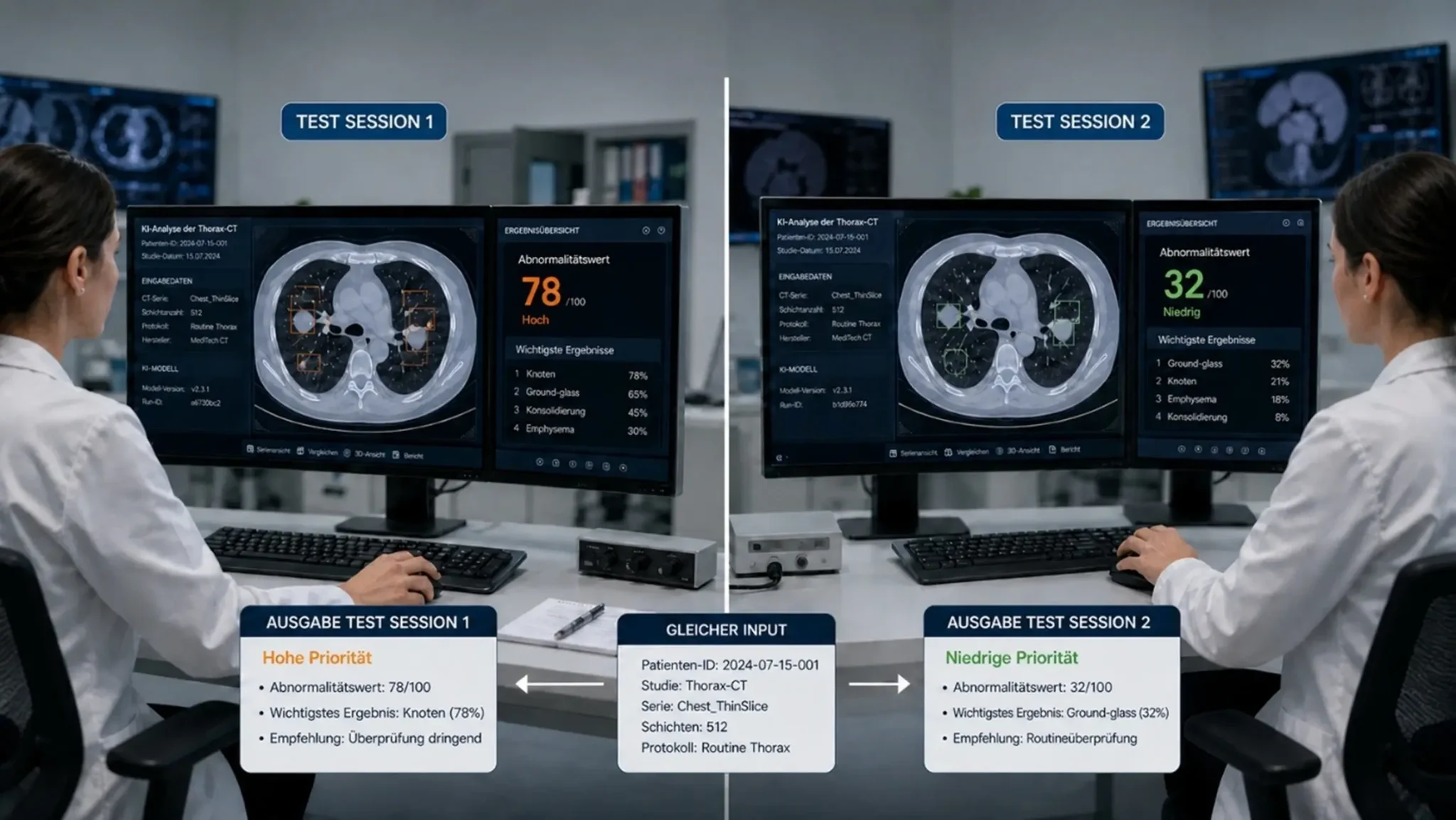
A further difference is that classic medical devices always respond identically to identical input, whereas AI medical devices, owing to their ability to learn, can deliver different results for the same situation. This dynamic depends on whether a system is trained only during development or keeps learning after market launch. Because the quality of the training data largely determines the quality of the AI, faulty inputs can lead to wrong conclusions.

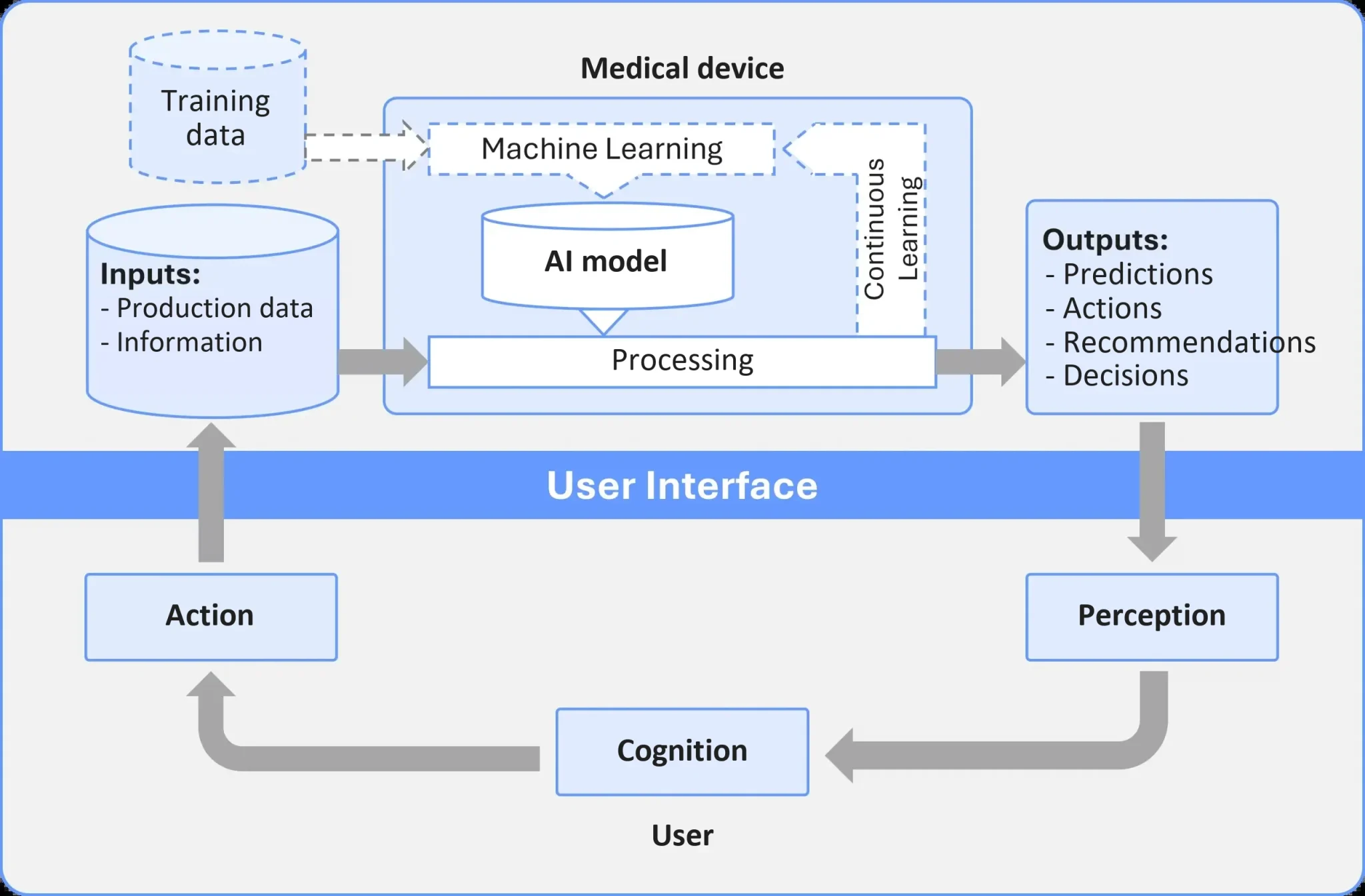
The following figure illustrates this human-AI interaction, which, based on the PCA approach (Perception, Cognition, Action), is represented as a closed loop between user and medical device.

Basic user interface schema for AI-enabled medical devices

Basic schema of human-AI interaction, adapted from Engler et al. Usability Engineering for

Medical Devices using Artificial Intelligence and Machine Learning Technology – A Position Paper of DKE UK 811.4 (2024)

The AI-enabled system processes data using machine learning and generates outputs such as predictions, recommendations or decisions, which are presented to users via the user interface. Users perceive the information (perception), interpret it (cognition) and act accordingly (action), which feeds new inputs back into the system. Because of continuous learning, these inputs may lead to system adaptations, which in turn can affect the interaction.

2Influences on the usability engineering process for AI-enabled medical devices

2.1 Use specification

The use of AI can automate manual tasks of clinical staff. This automation changes the demands on users and thus their user profiles (intended user profiles). The elimination of physically demanding tasks, for example, can influence the demographic composition of a user group (intended user group), which in turn affects the requirements for user interface specifications and training measures. In addition, workflows and tasks change, which may require new skills and experience.

Workplace and social exchange can also change significantly through AI-enabled medical devices. If action proposals or automated medical actions come from AI, professional exchange within the team can decrease. Automated medication delivery can also minimize interaction with patients and move workplaces further away from areas close to the patient.

These examples show how closely the context of use, the user interface and training measures are interlinked. The basic approach to determining the context of use remains unchanged, but a particularly careful analysis of users, their tasks and goals, the necessary resources and the use environment is required, because AI brings profound changes.

2.2 Task analysis (PCA task analysis)

AI medical devices can change workflows considerably. Instead of making diagnoses entirely on their own, radiologists, for example, already receive suggestions from the AI that serve as the basis for the final diagnostic decision. This initial orientation makes decisions easier but carries the risk that results are accepted without verification. A careful plausibility check is therefore essential.

PCA task analysis

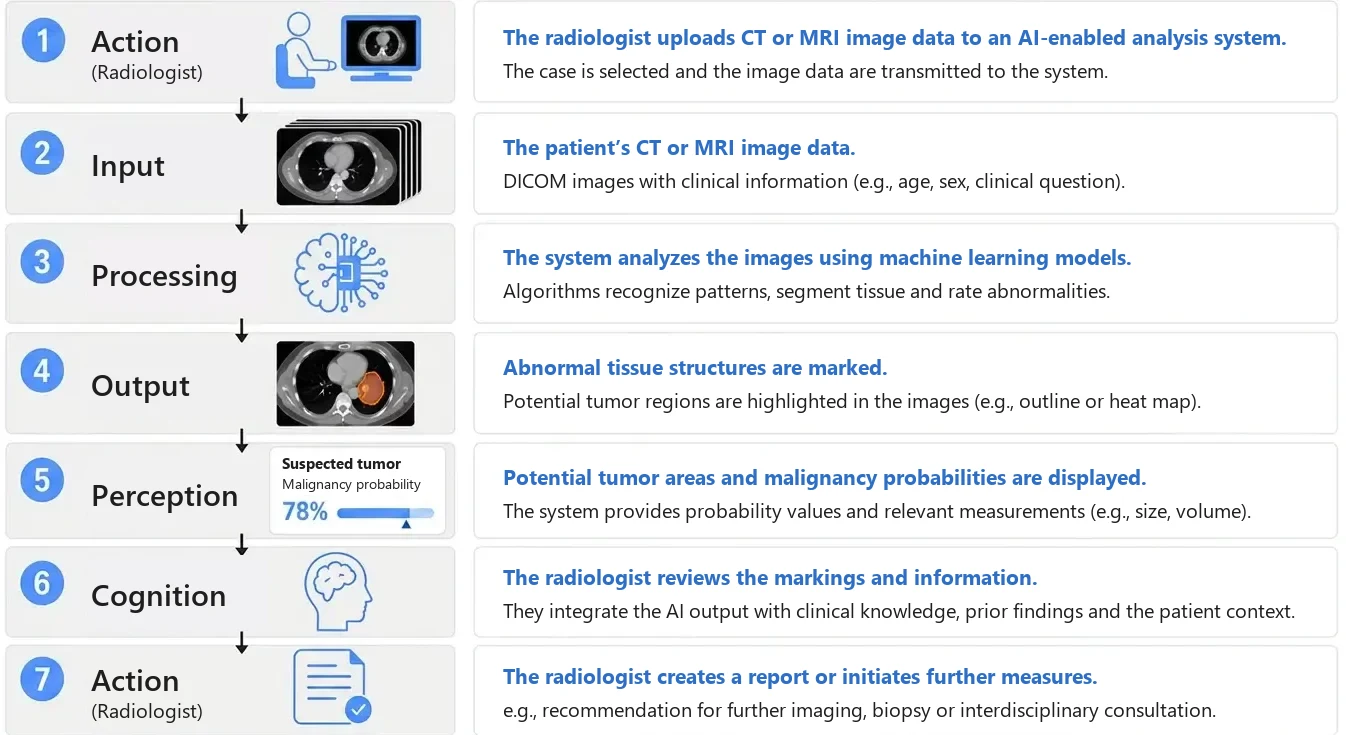
Despite these changes, it remains worthwhile to analyze existing workflows before product development begins, in order to identify tasks that can be automated and those that newly arise from AI-related challenges. The following example illustrates the differences between the current-state scenarios and the task models of the new product generation combined with AI:

The role of radiologists thus shifts from detailed image analysis to assessing the plausibility of the AI output. If the AI also performs actions automatically, the task focus shifts further toward monitoring instead of active execution.

Basic workflow diagram using the example of an AI-enabled medical device

2.3 Use errors in AI-enabled medical devices & resulting hazardous situations

The definition of a use error remains unchanged when interacting with an AI. Use errors comprise actions that users perform with the medical device, or the omission of a necessary action, that lead to a result different from what the manufacturer intended or the user expected and that may give rise to hazardous situations.

Because of the AI’s upstream medical action (e.g., recommendations, predictions, triage or decision support) and the necessary plausibility check, the cognitive demands on users shift in particular. Compared with classic systems that respond deterministically in identical situations, AI-enabled medical devices can produce varying outputs in similar situations. This variability can foster uncertainty and increase the need for professional judgment. In the use situation, assessing the output itself therefore becomes part of the interaction and a decisive cognitive task.

A key future question is how to assess causes and responsibilities when users follow an AI recommendation that turns out to be medically wrong. The EU AI Act defines actor roles for this purpose, such as provider and deployer (operator or user acting under their own authority). These role definitions structure obligations along the supply and use chain, but they do not automatically resolve the practical question, case by case, of whether a failure was caused by

a) a system or information error,
b) a use error or
c) a combination of both factors.

Several uncertainties arise from this for the use error analysis:
AI outputs are not always “perfect” but can be probabilistic, incomplete or context-sensitive. A wrong or suboptimal output can be interpreted both as an expected residual risk within defined performance limits and as an indication of a product or information error (e.g., insufficient robustness, unclear intended use, missing warnings, lack of transparency about limits).
At the same time, blindly following the AI without a plausibility check can count as a use error, because it is the omission of a necessary action that is required for safe and intended use.
In practice, combined causes are realistic: a suboptimal AI output (system side) plus an insufficient plausibility check (use side) can together contribute to a hazardous situation. The root cause analysis must therefore separate systematically: What was recognizable to users in the use situation, which information and signals were available, and which actions could realistically be expected?
The plausibility check thus becomes a critical user task and at the same time a risk control measure whose effectiveness depends not only on user competence but also on support from the system (e.g., transparency, explanatory notes, warnings, display of uncertainty, logging and traceability). The AI Act addresses this lifecycle perspective through obligations for high-risk systems, in particular through requirements for traceability, documentation and post-market monitoring. Providers of high-risk AI must operate a post-market monitoring system that collects and analyzes performance data over the lifetime of the system in order to detect continued conformity as well as risks and changes in performance.

In summary, intervening or not intervening in the case of faulty, uncertain or ambiguous AI, as well as the final medical action, plays a central role in identifying use errors (and deriving suitable risk controls). Plausibility checks that are not performed or are insufficient are a plausible and probably frequent cause of error in AI-supported use contexts. At the same time, the distinction remains subject to uncertainty in practice: whether an omission counts as a use error depends largely on whether the manufacturer adequately supports the necessity, scope and feasibility of the plausibility check in the specific use situation (among other things through understandable information, a suitable UI, warnings, and traceable limits and uncertainties of the system). The exact implementation will only become clear in the future. The identification of hazard-related use scenarios can be explored in more depth in our knowledge base.

2.4 Usability evaluations

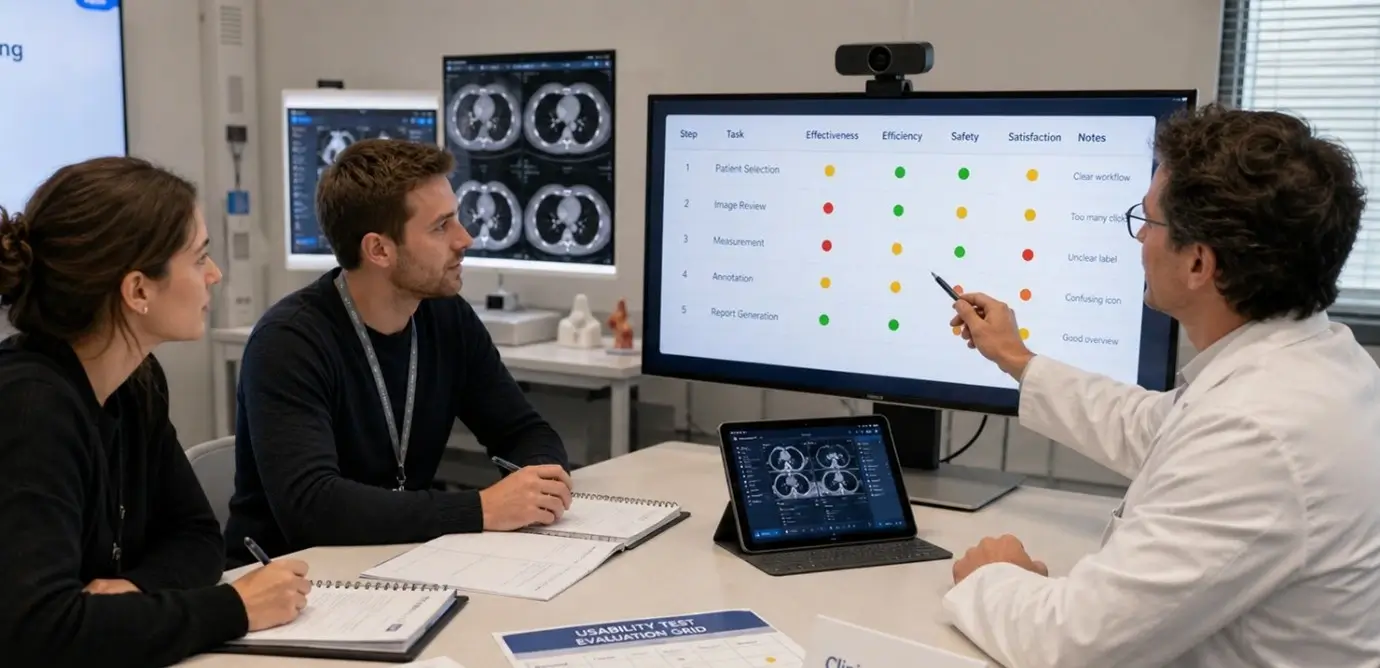
The challenges described in chapter 2.3 directly affect the planning, execution and interpretation of usability evaluations. Classic medical technology tests generally assume that a system delivers consistent and medically correct information for identical input. AI medical devices change this basic assumption: a test participant can interpret the displayed information correctly and apply it formally “right”, and still arrive at a medically wrong result if the AI output itself is faulty. This is where the plausibility check required of users and the related challenges explained in chapter 2.3 come into play. For the assessment in the usability test, the question therefore arises whether an observed problem should be classified as a use error or as a system error (or product error).

Usability teams therefore need extended clinical expertise in the test setting to avoid medical misjudgments by the moderator and note-taker team. This can be supported by the presence of clinical experts, prepared medical reference paths or closely aligned evaluation criteria.
Usability evaluation
A further challenge arises from potentially variable AI outputs: learning or adapting models can deliver different results for the same test input in different test sessions. For usability evaluation, this means that test protocols and acceptance criteria must be designed flexibly so that different system responses can be classified correctly. At the same time, evaluators must define clearly how to handle diverging outputs in order to ensure both repeatability and comparability between tests.
Usability test session

Overall, AI medical devices (AI-enabled medical devices) mean that usability evaluations must distinguish more strongly between interpretation errors by users and content errors of the system. Both can look similar but have different causes, risks and regulatory consequences. As a result, multidisciplinary teams, medical reference standards and precise documentation of system outputs during the test become far more important than in classic usability studies.

2.5 Post-market surveillance

Especially for AI-enabled medical devices that continue to be adapted or updated after market launch, post-market surveillance (PMS) gains considerable importance. Manufacturers must ensure that users can use the product efficiently and safely even when outputs change due to new training data or model updates.

The EU AI Act obliges manufacturers to maintain extended monitoring, reporting and documentation processes in order to continuously check model performance, data drift and possible interactions with other AI-enabled medical devices. These AI-specific requirements extend classic PMS and thus also affect the long-term assurance of high usability.

Usability Engineering for AI-enabled Medical Devices: Conclusion

AI fundamentally changes medical technology: instead of deterministic, clearly predictable system responses, dynamic, context-dependent outputs emerge that place new demands on users and their decision-making. In particular, the necessary plausibility check of AI results becomes the central user task and at the same time a critical risk control measure. Roles, workflows and potential sources of error shift markedly, and the clear distinction between use error and system error becomes more complex.

For manufacturers this means: usability engineering must be thought of earlier, deeper and more interdisciplinary, from the use specification to post-market surveillance. Only an integrated interplay of UX, clinical expertise, risk management and AI development can deliver safe, understandable and standards-compliant AI-enabled medical devices.

Support from USE-Ing.
If you are developing or further developing AI-based medical technology, we are happy to support you, for example with:

  • Adapting your usability engineering process to AI systems
  • Conducting PCA analyses and use error assessments
  • Developing understandable and safe user interfaces for AI outputs
  • Planning and conducting AI-specific usability tests
  • Integrating regulatory requirements (IEC 62366, EU AI Act)
Feel free to get in touch. We will bring your AI-enabled medical devices into practice safely, user-centered and in compliance with standards.

Disclaimer

The information presented in this technical article regarding standards and regulatory guidance has been prepared to the best of the author’s knowledge and expertise. It reflects solely the opinion of the author. No guarantee can be given for the completeness, currency, or accuracy of the information provided. Standards and regulations are subject to regular revisions and updates, which may not always be reflected here in real time. This article does not constitute binding advice and does not replace a review of the applicable standards and regulatory requirements by qualified professionals or official bodies. For the application and interpretation of standards and regulatory guidance, the currently valid original documents and the respective authoritative organizations are always decisive.

Contact e1749215510462

As usability engineering specialists, we at USE‑Ing. support you in developing AI-based medical technology. Benefit from our expertise, from concept to implementation. Do you have questions? Feel free to talk to us.

The USE-Ing. Compass

Stay on course with our newsletter